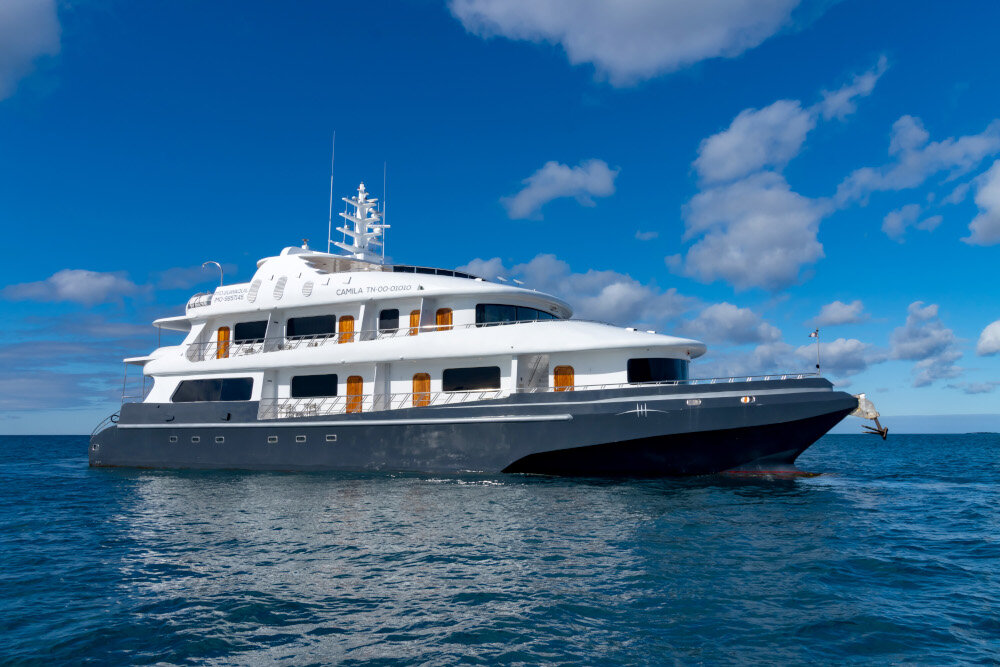
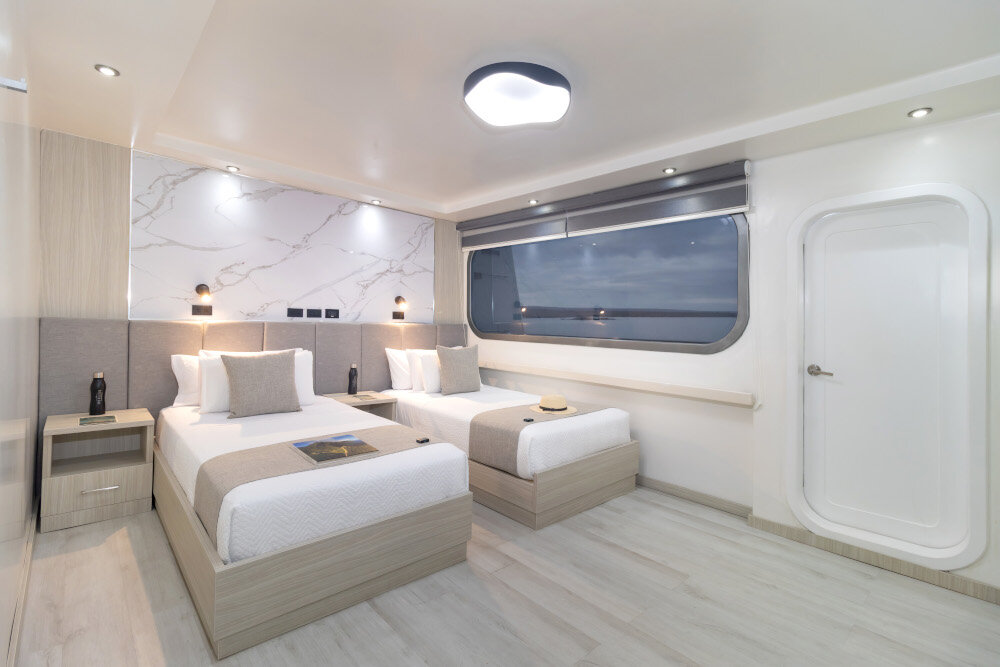
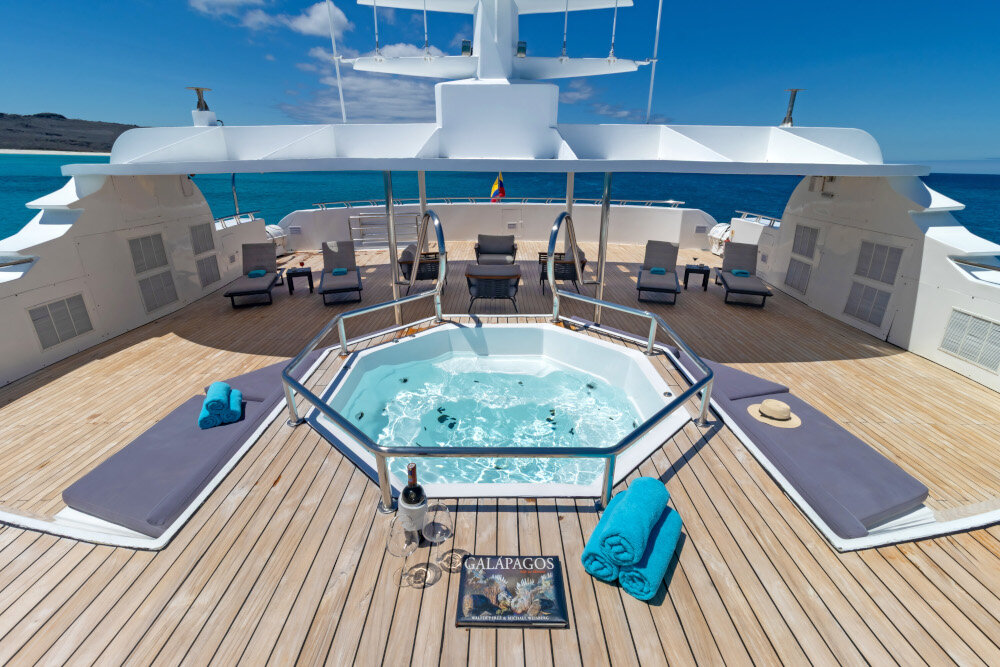
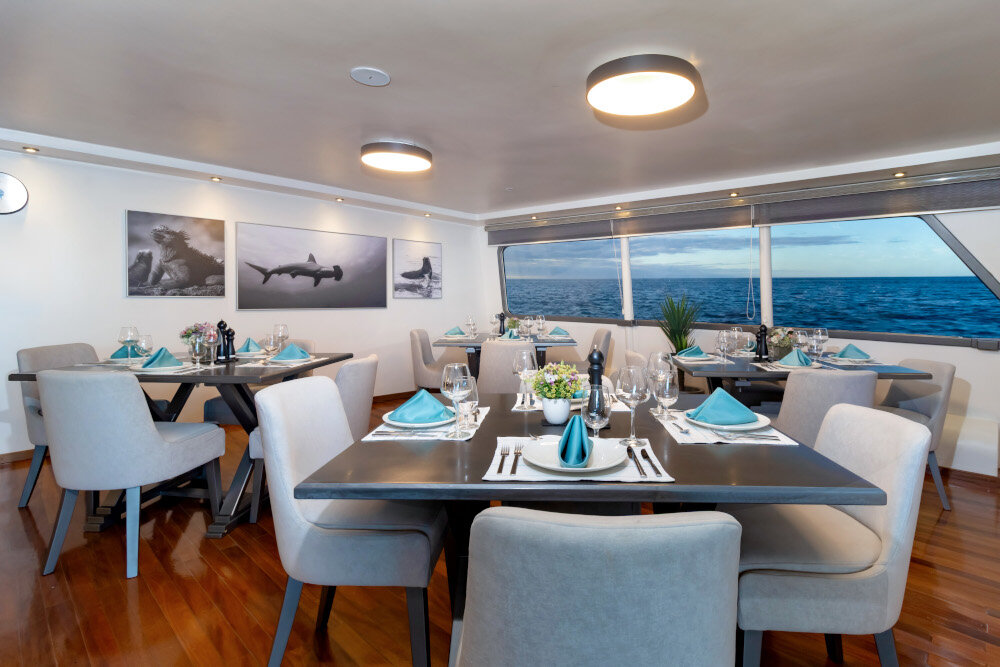
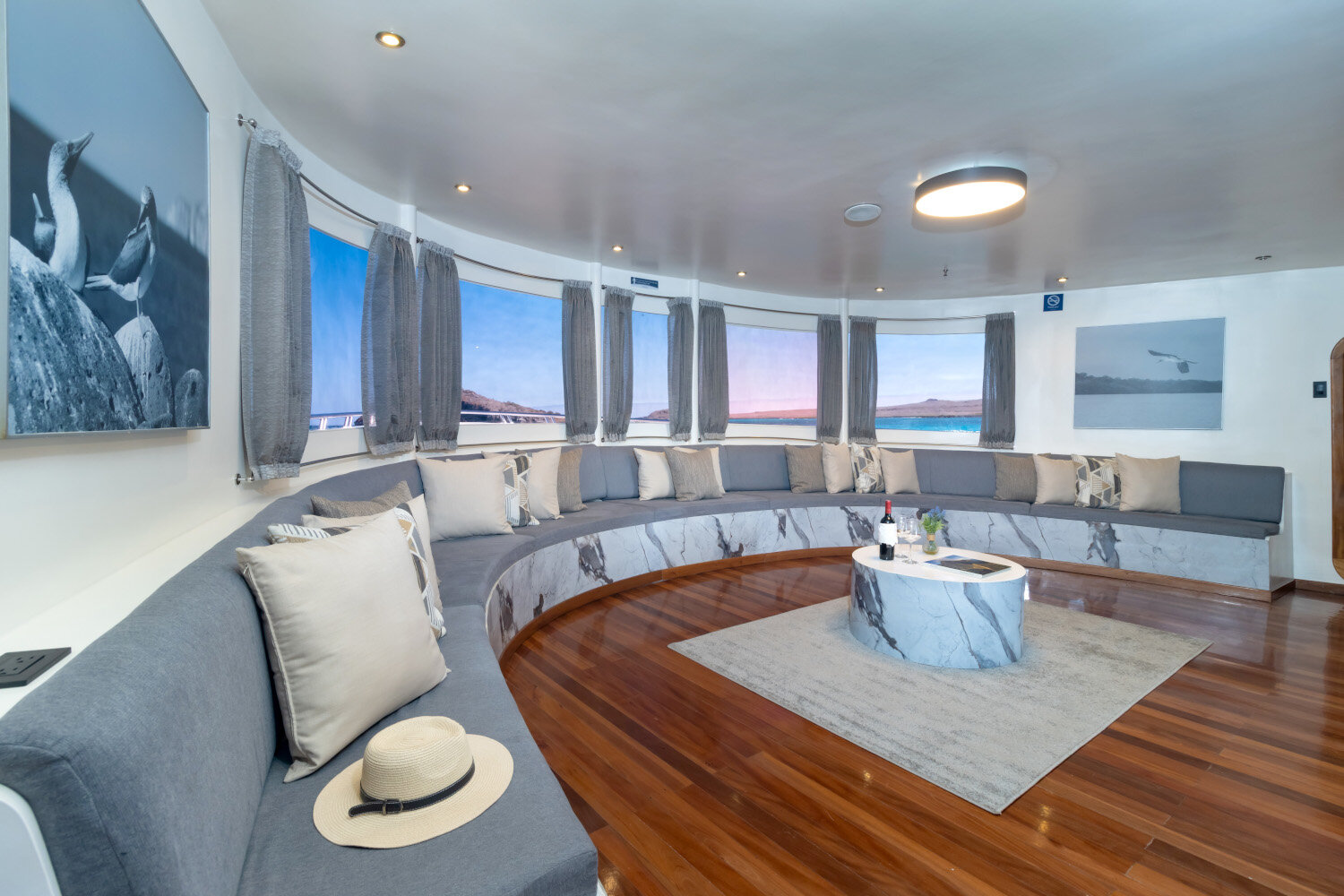
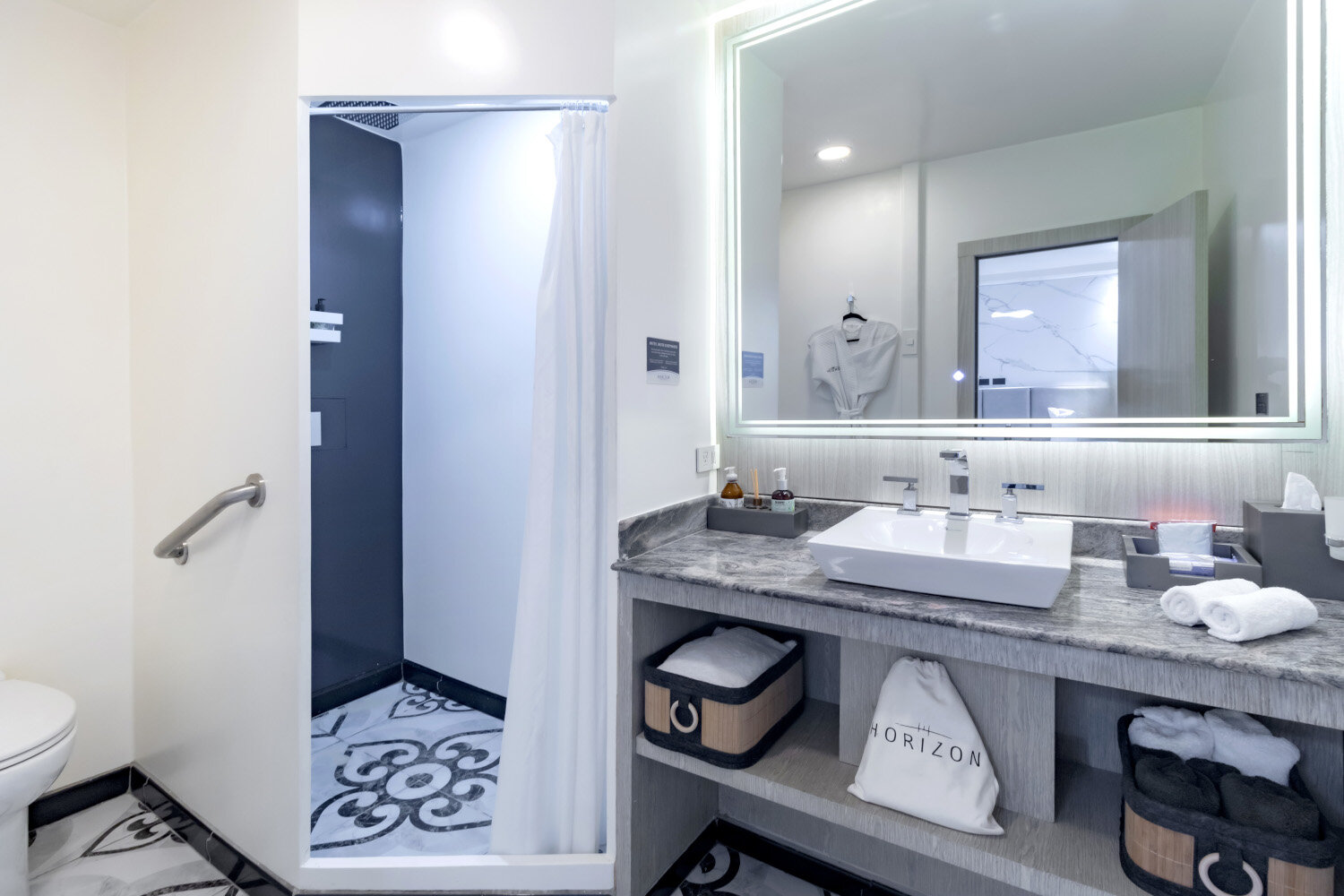
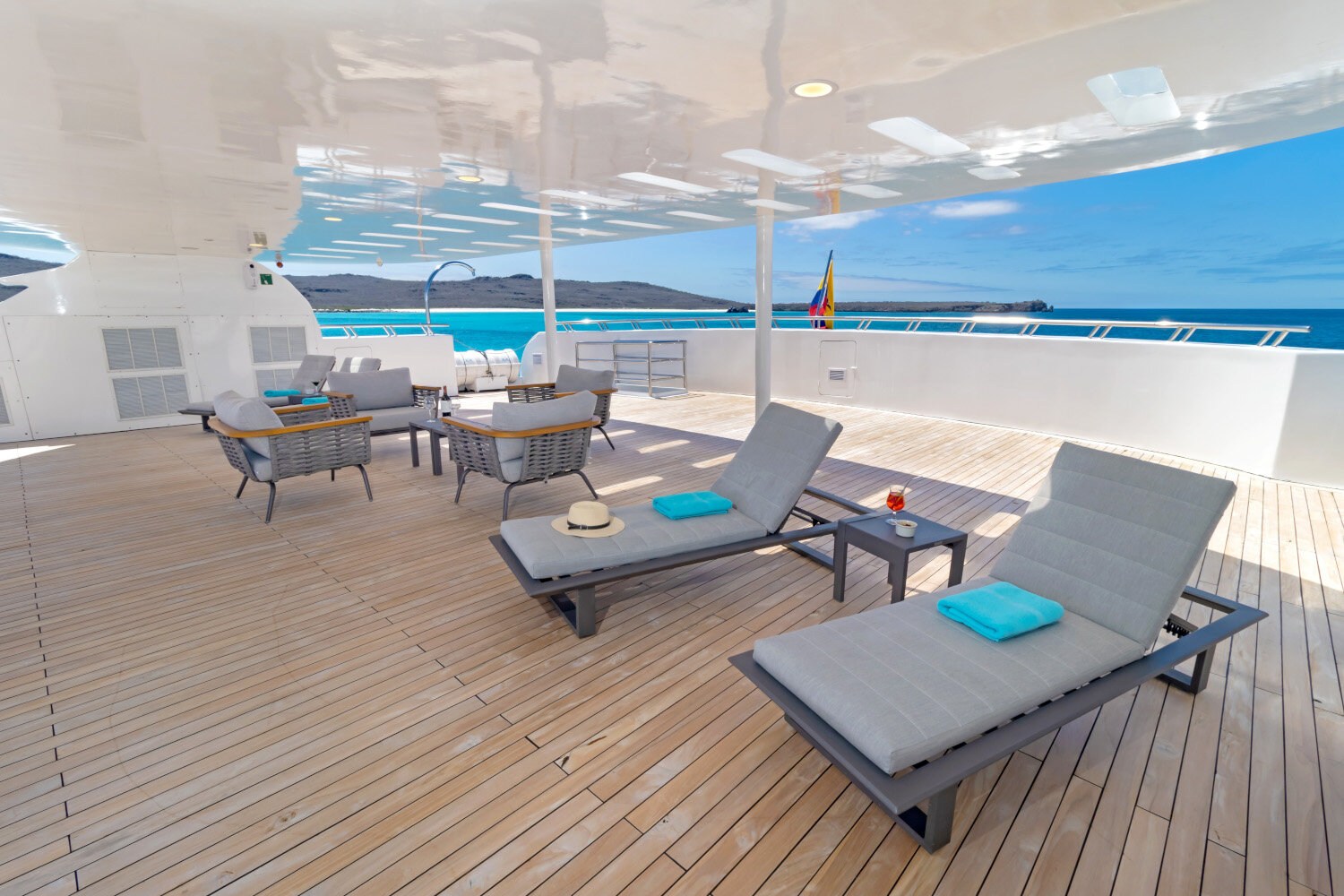
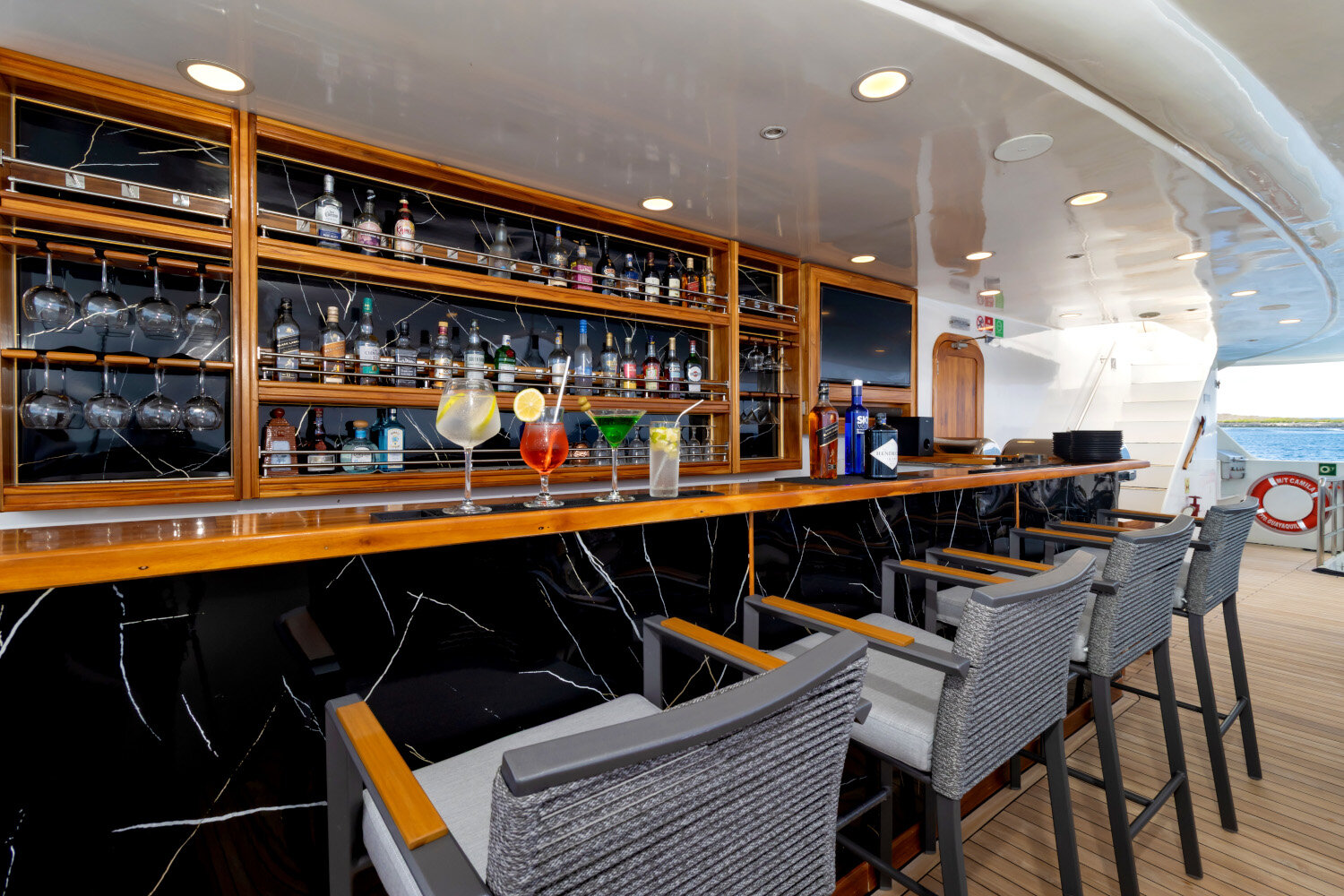
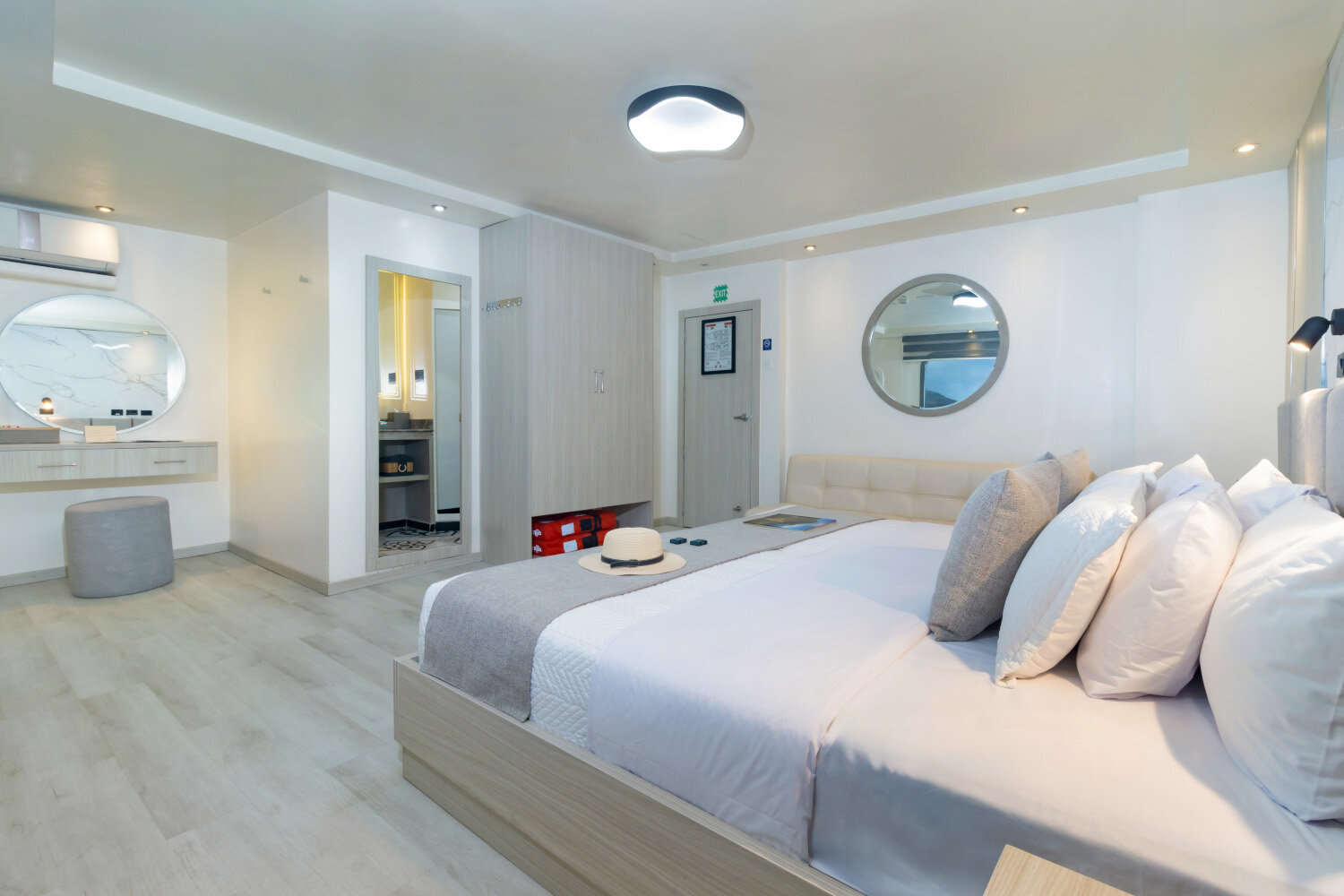
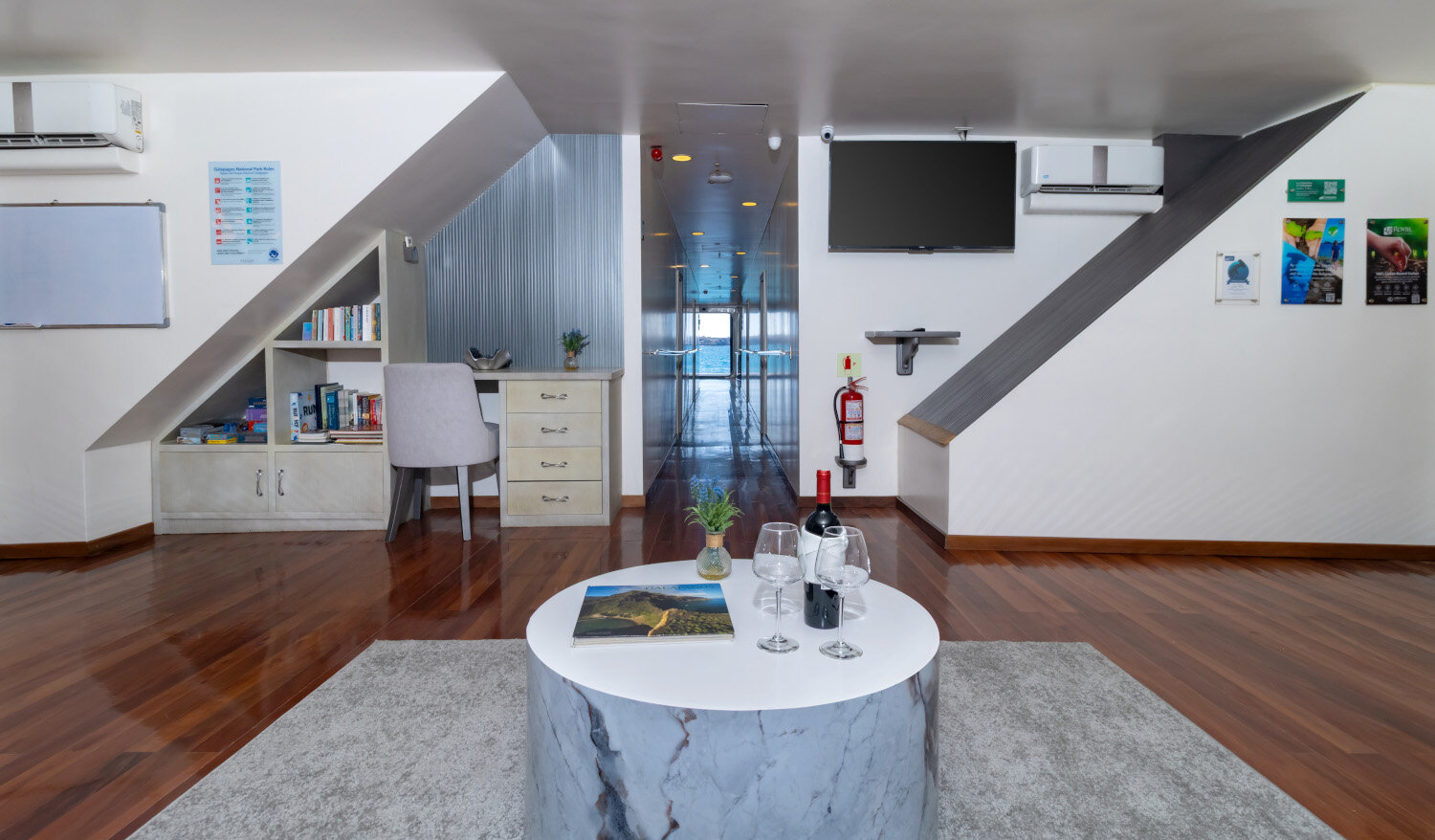
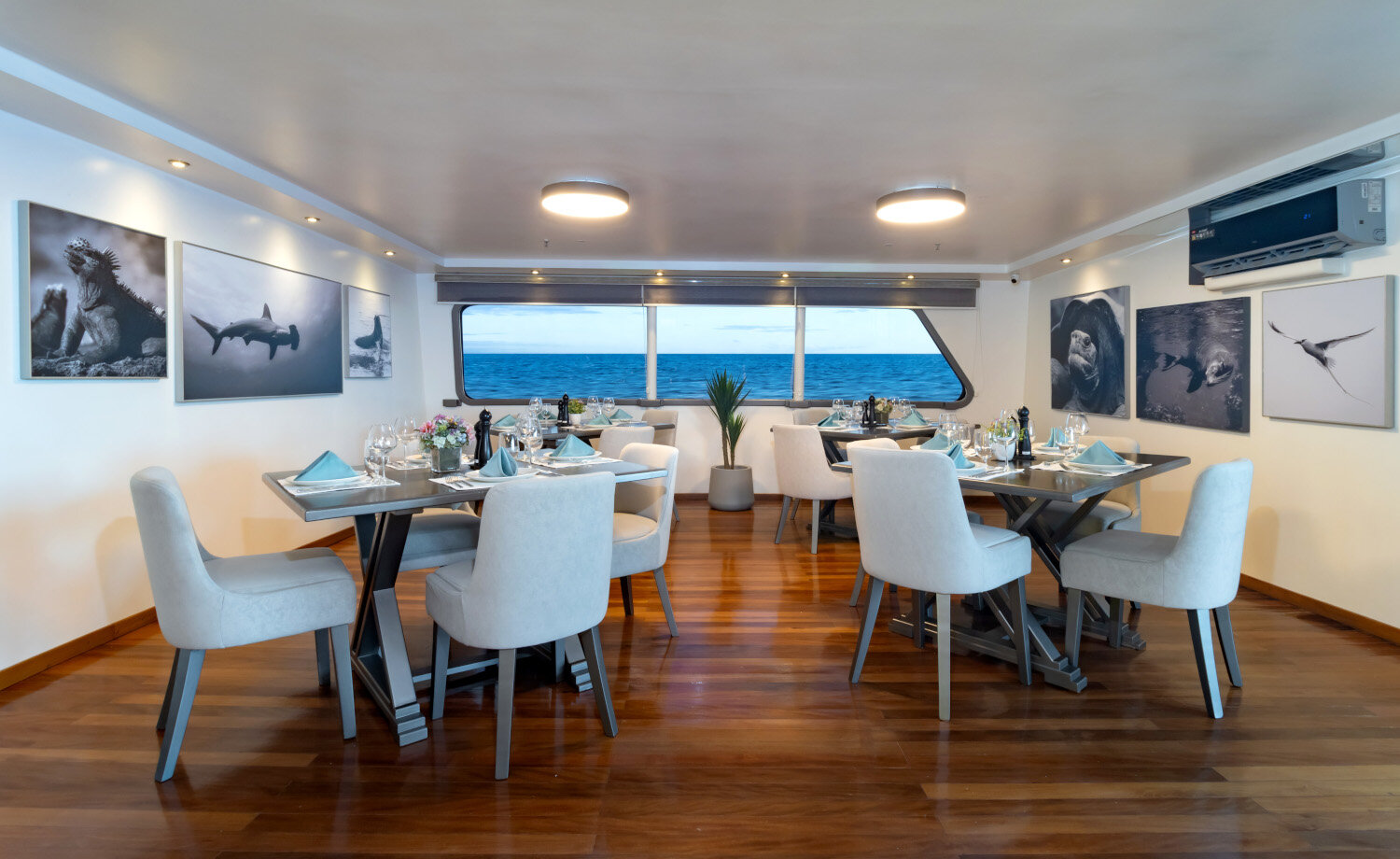
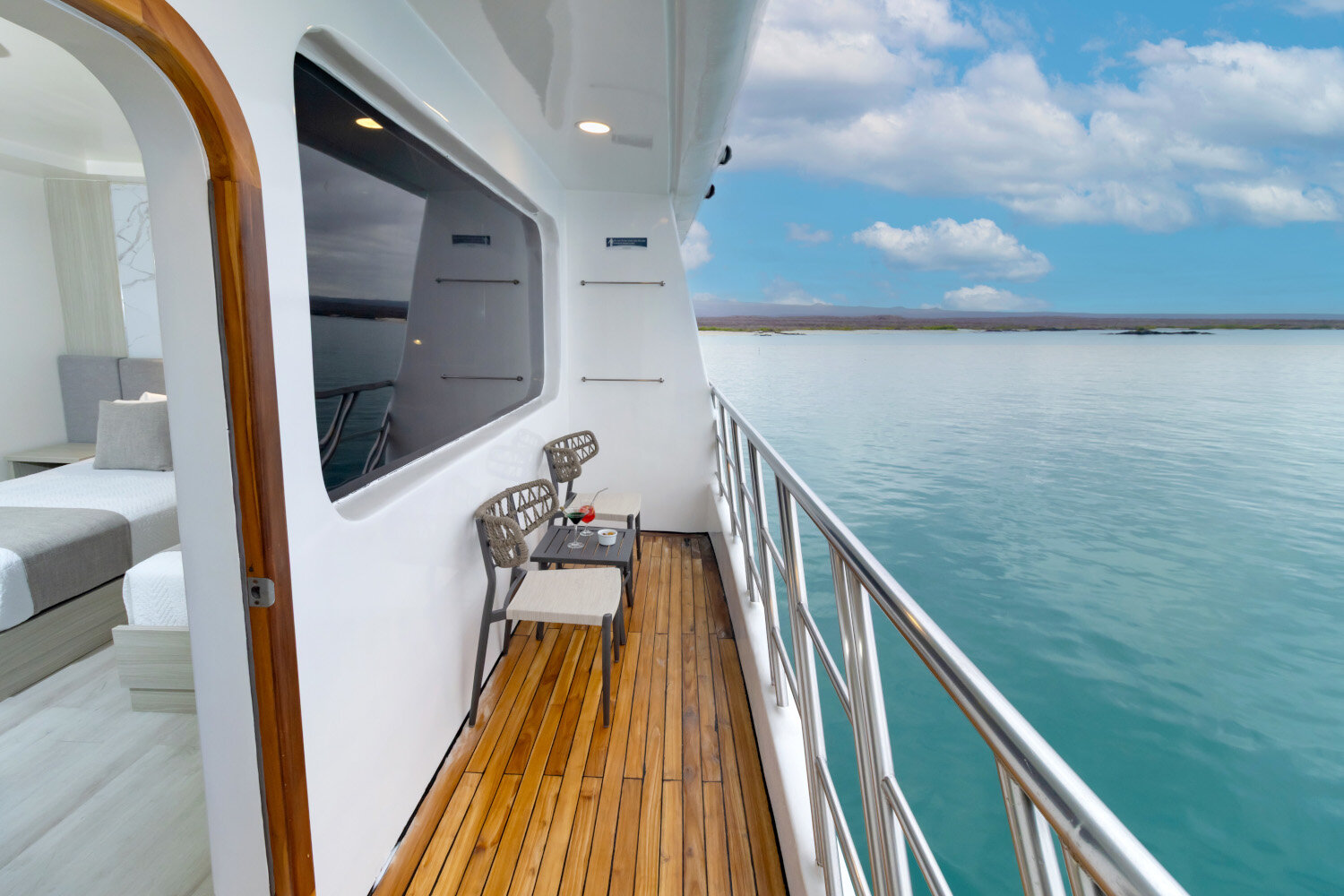
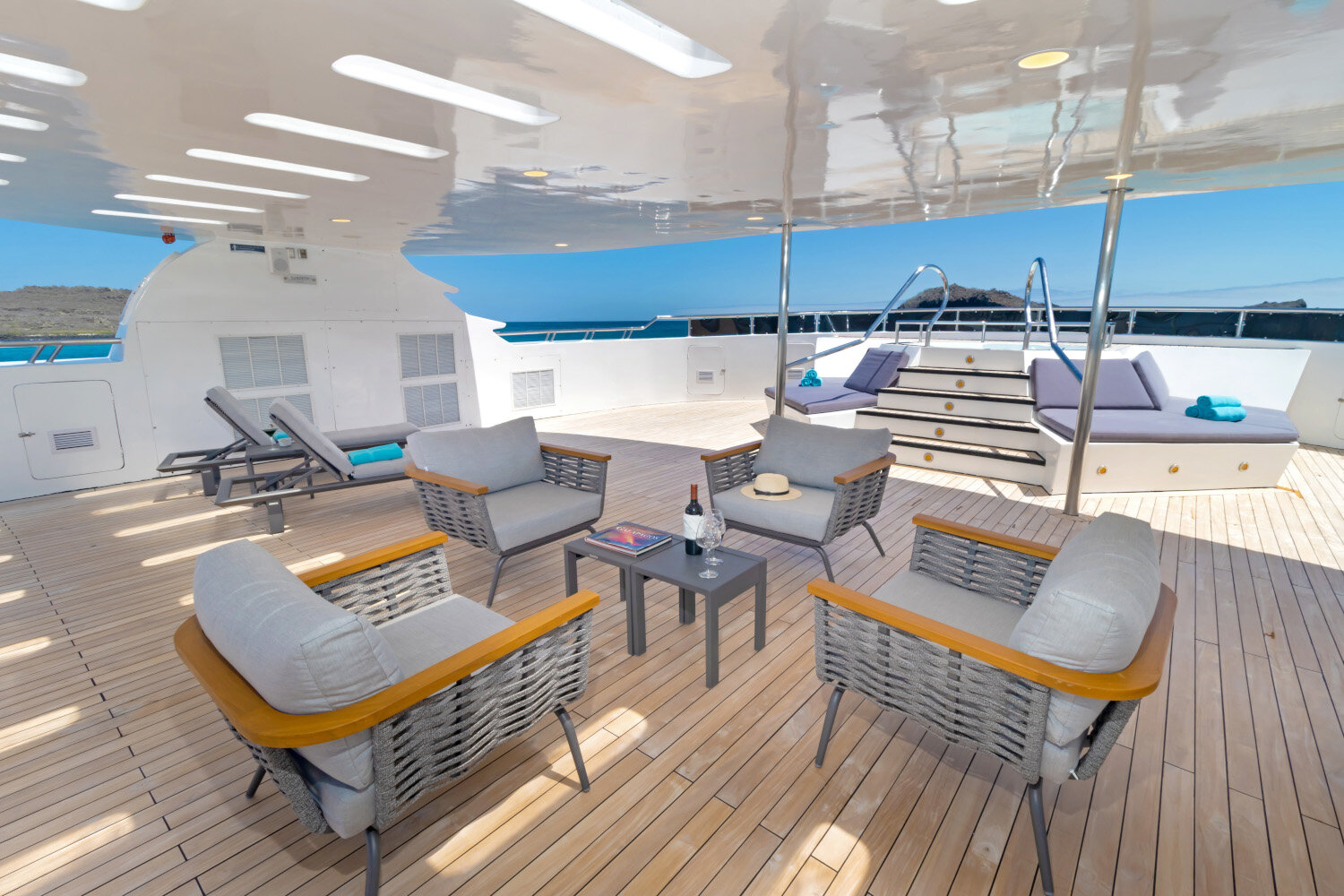
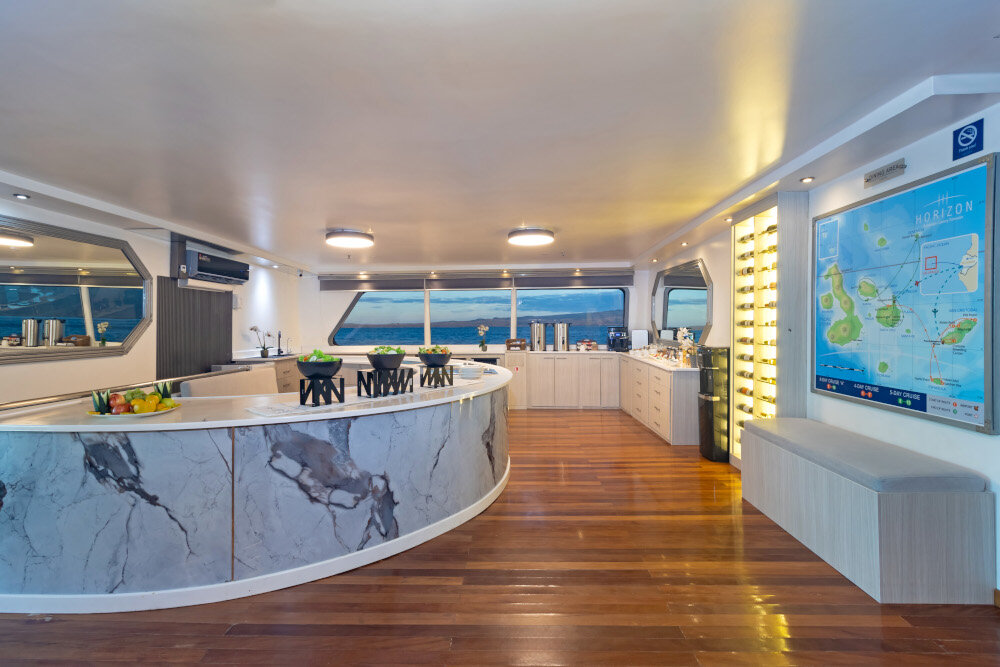
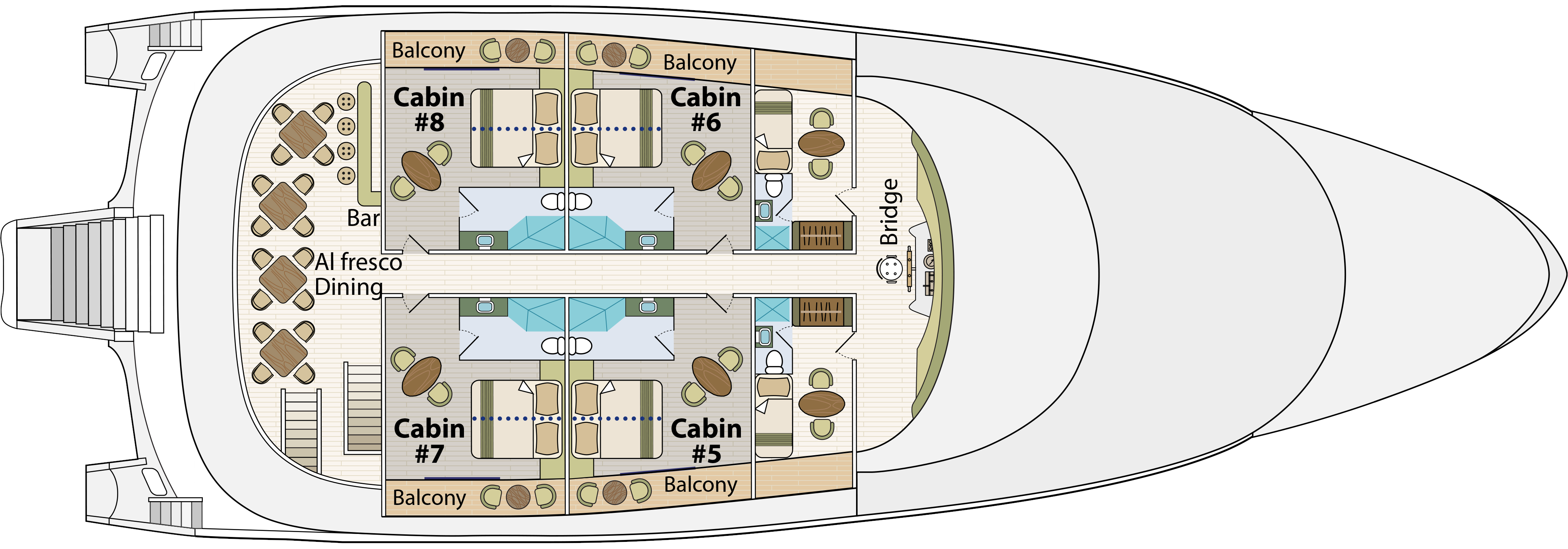
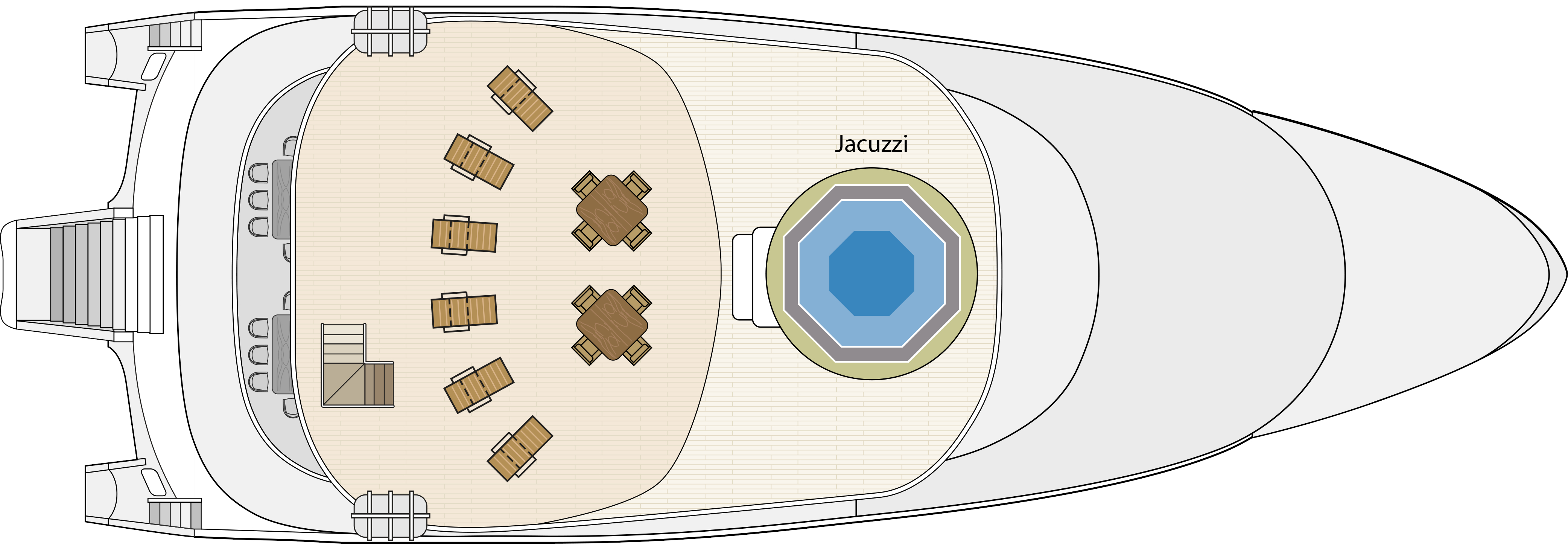
Horizon is the only trimaran in the Galapagos and is outfitted with 8 elegant and spacious cabins, each with their own private balcony. Her amenities include a modern lounge, bar, al fresco dining area, and an extensive solarium with jacuzzi on the top deck.
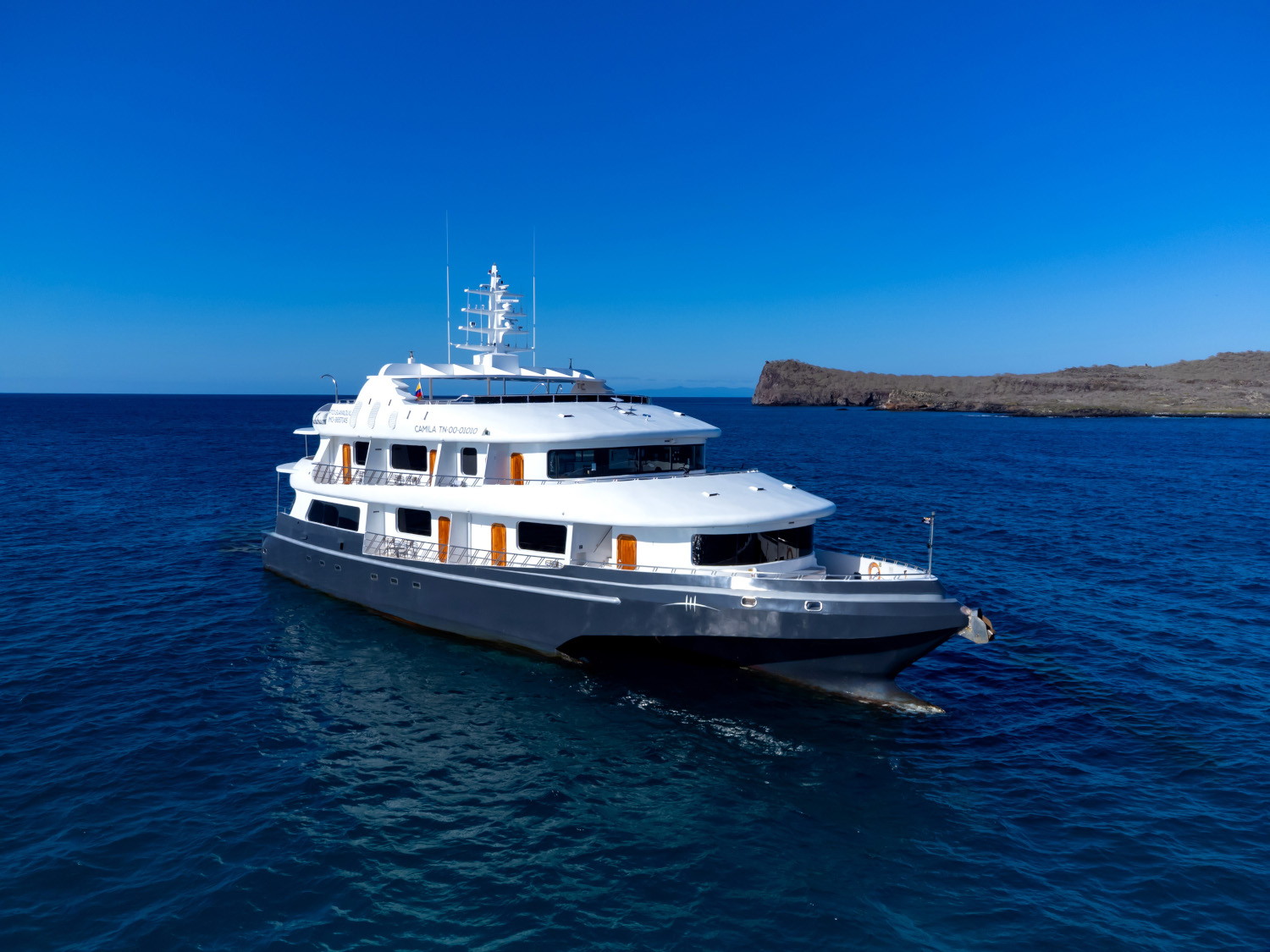
Horizon takes a maximum of 16 guests in 8 cabins, led by a bilingual naturalist guide certified with the Galapagos National Park, whilst your onboard comfort is taken care of by crew and yacht safari director. There are a total of 6 itineraries to choose from ranging from 4 - 8 days.
Technical Specifications
| Year of construction: | 2018 |
| Length | 125ft (38m) |
| Beam | 43ft (13m) |
| Draft | 6.2ft (2m) |
| Speed | 11 knots |
| Capacity | 16 guests |
| Main engines | 2xSCANIA Diesel Engines DI13 070 550HP |
| Accommodation |
- Upper Deck: 4 double cabins *All cabins with private balconies, private bathrooms, hot water and air-conditioning |
| Safety & Navigation | All equipment meets or exceeds the international SOLAS standard, 2x 25-man life raft, Navtex 300TX FURUNO, 2 GPS, Depth Sounder, 2 naval radars, Fire detection and prevention systems etc. |
Deck Plans
Main Deck
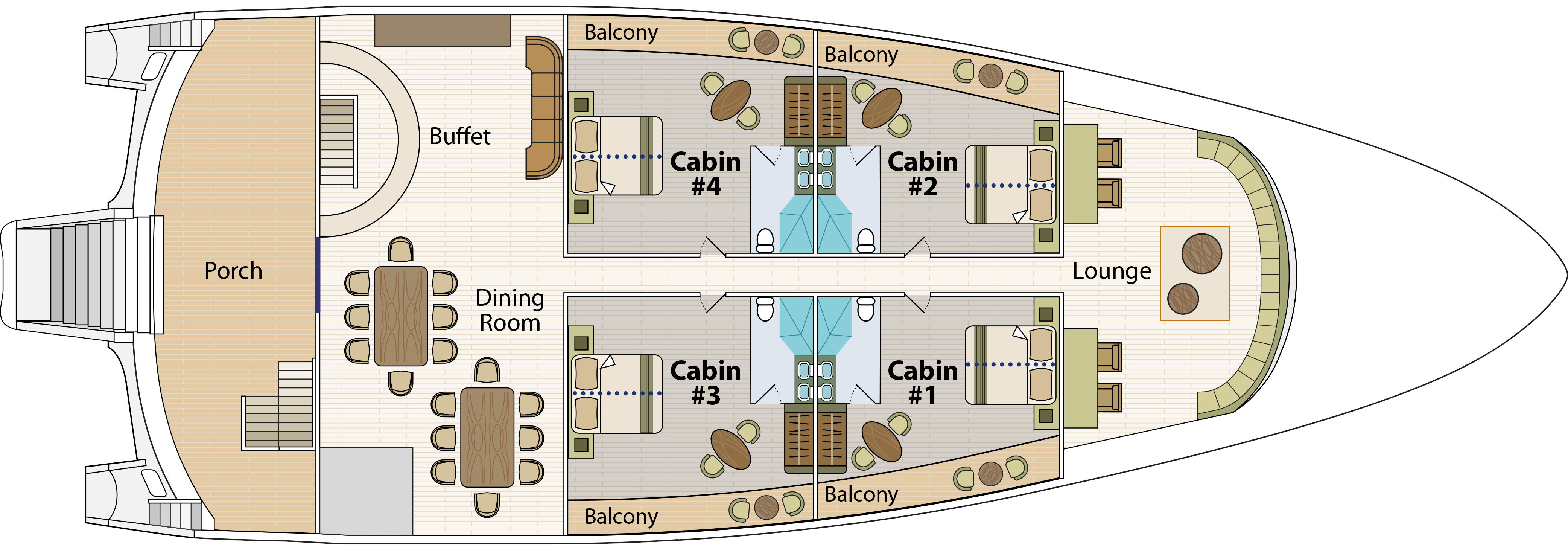
Upper Deck
Sundeck
Itinerary
Please note that these itineraries are subject to change without notice due to seasonal changes, last minute weather conditions and the decision of the Galapagos National Park authority.
Itinerary A – East (8 days / 7 nights)
Day 1 (Saturday) - San Cristobal Island
AM: San Cristobal Airport Arrival
You will arrive at San Cristobal Island in the morning.
After passing through immigration and baggage claim, you will be met by a Horizon staff member and transferred to the yacht. You will be shown to your cabin where you will have some time to settle in before lunch and a welcome briefing.
PM: David Rodriguez Breeding Centre ''La Galapaguera''
Breeding Centre David Rodriguez - “La Galapaguera”, in Cerro Colorado, is a new visitor site in the southeast part of San Cristobal Island and can now be reached in roughly one hour by road from Puerto Baquerizo Moreno. On the trees and shrubs surrounding the site, you may see land birds like warblers, finches and mockingbirds. Giant tortoises can be observed on the trails. They live there wild but in a protected area to ensure their survival by sealing them off from introduced predators like pigs and goats.
Day 2 (Sunday) - San Cristobal Island
AM: Pitt Point
Pitt Point, situated on the north-eastern tip of the San Cristobal island, hosts frigate birds, storm petrels, and all three types of booby birds: the Nazca, blue-footed and red-footed boobies. A steep trail goes up a cliff and through a ravine leading visitors to an area with an abundance of birds.
PM: Witch Hill
Located on the northern coast, this eroded hill and its surroundings present one of the most picturesque beaches in the Galapagos with its white powdery sand and the abundance of animals. Wildlife includes sea turtles, rays, and various types of booby birds. The clear water provides an excellent opportunity for enjoying swimming and snorkelling.
Afterwards: Kicker Rock
This striking rock formation is located a couple hours off the western shore of San Cristobal. Jutting out of the water, the rocks stand vertically at hundreds of feet above the ocean divided by a small channel. Although there are no landing areas, circumnavigation allow visitors to spot a variety of marine life.
Day 3 (Monday) - Espanola Island
AM: Suarez Point
On the trail to Suarez Point you will have the chance to spot blue-footed boobies, albatrosses, and Nazca boobies. This island is the breeding site of nearly all of the world’s 12,000 pairs of waved albatrosses. You will also visit a beautiful site on the ocean front where there is a cliff that the large albatrosses use as a launching pad! You will have the chance to see the famous blowhole that spurts sea water into the air. The landscape is great for photography.
PM: Gardner Bay, Gardner Islet & Osborn Islet
This excursion takes you to the spectacular Gardner Bay. After landing, you can walk across a lovely white-sand beach amongst a busy sea lion colony or dive into the water to swim with sea lion pups. You may also see curious mockingbirds on the beach.
Day 4 (Tuesday) - Santa Cruz & Bartholomew Islands
AM: Bachas Beach
Bachas Beach is located on the north shore of Santa Cruz and is a beach for swimming. One of the few remnants of the U.S. World War II presence in the Galapagos, a floating pier, can be seen here. You may see flamingos, Sally Lightfoot crabs, hermit crabs, black-necked stilts, and whimbrels. Sea turtles also nest on the beach.
PM: Pinnacle Rock
You will head to Bartholomew Island where the famous Pinnacle Rock is found. Bartholomew consists of an extinct volcano with a variety of red, orange, black and even green volcanic formations. We will take a trail of stairs to the summit of the volcano (about 30 or 40 minutes) where you will enjoy one of the best views of the islands! A beautiful beach surrounded by the only vegetation is perfect for snorkelling where you may even see and swim with Galapagos penguins.
Day 5 (Wednesday) - Santiago & Rabida Islands
AM: Egas Port
Egas Port, also known as James Bay, on Santiago Island is home to the curious Galapagos hawks and quick-footed Galapagos lava lizards. The trail leads to the coastline with gorgeous tide pools and grottos full of fauna. Here the Galapagos fur seals bathe in the sun. This is also a great snorkelling site.
PM: Rabida
You will visit Rabida Island (or Jervis) which is one of the most colourful and volcanically varied islands in the archipelago as well as a great snorkelling site. We will start on Rabida’s famous maroon/red sand beach, and after an easy hike, you will arrive to a stunning lookout to enjoy the amazing landscapes. The island is a birdwatcher’s delight. Some species are abundant such as a few varieties of finches, Galapagos vermilion flycatchers, Galapagos hawks and brown pelicans.
Day 6 (Thursday) - Genovesa Island
AM: Darwin Bay
Visit the white-sand coral beach of Darwin Bay which includes a half mile trail (0,75km) that winds through mangroves filled with land birds. Nazca boobies, red-footed boobies, and swallow-tailed gulls, which can easily be spotted here. Further down the path we’ll find tidal pools where sea lions swim playfully. At the end is a spectacular view of a cliff.
PM: El Barranco
El Barranco, also known as Prince Phillip’s Steps, is a steep, rocky path that leads up a high cliff rock face. A marvelous view can be appreciated from here. This site is also home to Palo Santo vegetation as well as red-footed boobies, short-eared owls, Galapagos storm petrels, and Galapagos doves.
Day 7 (Friday) - Mosquera & Santa Cruz Islands
AM: Mosquera Islet
Mosquera Islet is located between the islands of Baltra and North Seymour. This reef of rocks and coral (the result of an uprising) is only 160 meters across at its narrowest width. This island has one of the largest populations of sea lions and is home to many shorebirds. There have been occasional reports at this site of orcas feeding on sea lions.
PM: Highlands
Accessible by bus from Puerto Ayora, the highlands of Santa Cruz are a deep green which contrast beautifully with the dry, lower part of the islands. The predominant vegetation in the highlands are Scalesia trees which create a lush green forest. The lava tunnels, over half a mile long, are underground and walking through them is a unique, surreal experience. At this place you’ll have lunch.
Afterwards: Fausto Llerena Breeding Centre
You will visit “Fausto Llerena” Tortoise Breeding Centre in Puerto Ayora, where giant tortoises are bred in captivity. This is home to tortoises ranging from 3-inches (new hatchlings) to 4-feet long adults. Subspecies of the giant tortoises interact with one another, and many of the older tortoises are accustomed to humans stretching out their heads for a photo opportunity. The babies are kept until they are about four years-old and strong enough to survive on their own.
Day 8 (Saturday) - North Seymour Island
AM: North Seymour
In North Seymour you may see Galapagos sea lions, blue-footed boobies, and magnificent frigate birds which are abundant on this island. North Seymour was formed by a series of submarine lava flows containing layers of sediment that were uplifted by tectonic activity. The island is characterized by its arid vegetation zone.
Afterwards: Baltra Airport Departure
After this final visit, you will be transferred to the Baltra airport in time for your flight back to the mainland.
Itinerary A5 – Northeast (5 Days / 4 Nights)
Itinerary A4 – Southeast (4 Days / 3 Nights)
Itinerary B (8 days / 7 nights)
Day 1 (Saturday) - Baltra Airport Arrival
AM: Arrival, Baltra Island
Morning flight from Quito or Guayaquil to Baltra, Galapagos Islands.
You will arrive at Baltra Island in the morning. After passing through immigration and baggage claim, you will be met by a Horizon staff member and transferred to the yacht. You will be shown to your cabin where you will have some time to settle in before lunch and a welcome briefing.
PM: Sullivan Bay, Santiago Island
You will visit Sullivan Bay located on the southeast part of Santiago. This place is interesting for its geology because the area is covered by lava flows. This place has elevations in the form of small volcanoes formed by the lava flows.
Day 2 (Sunday) - Isabela & Fernandina Islands
AM: Punta Vicente Roca, Isabela Island
Comprised of two separate coves, Vicente Roca Point is a large bay with spectacular sea life. Keep an eye out for seahorses, sea turtles, and the strange yet fascinating Mola mola (or sun fish) while you snorkel.
PM: Punta Espinoza, Fernandina Island
Crossing the Bolivar Channel that divides Isabela and Fernandina Islands, you will land at Espinoza Point, and after walking past a colony of marine iguanas and a group of sea lions, you will reach the island’s highlight: the flightless cormorant nesting site. This area also provides a great opportunity to see the Galapagos hawk.
Day 3 (Monday) - Isabela Island
AM: Tagus Cove, Isabela Island
You will visit Tagus Cove on Isabela Island which is located across from Fernandina Island, near the Bolivar Channel dividing the two islands. This spot has been frequented by ships since the 1800s, using the area as an anchorage site. Trails winding by Lake Darwin up to a ridge display wonderful views.
PM: Urbina Bay, Isabela Island
Urbina Bay is located at the base of Alcedo Volcano on the west coast between Tagus Cove and Elizabeth Bay. This area experienced a major uplift in 1954 causing the land to rise over 16 feet. The coast expanded half a mile out leaving marine life stranded on the new shore. This area is also a great place for snorkelling.
Day 4 (Tuesday) - Isabela Island
AM: Elizabeth Bay, Isabela Island
Elizabeth Bay is located on the east coast of Isabela Island. The bay contains many islets, which can be visited by dinghy. Penguins and blue-footed boobies can be spotted on the rocky islets. With an abundance of marine life and clear water, the area is perfect for snorkelling and viewing schools of colourful fish, sea lions, and perhaps even sharks.
PM: Punta Moreno, Isabela Island
Moreno Point is located southwest of Elizabeth Bay. Here a dry landing onto what was once flowing lava is possible. The lava has left craters in its wake which formed crystal tide pools. By looking into the pools, you can peer into another world as the marine life drifts by your window. In the brackish pools of this area, you may see pink flamingos, white-cheeked pintails, and common gallinules. If you look carefully into the pools, you may see white-tip reef sharks and some sea turtles.
Day 5 (Wednesday) - Santa Cruz Island
AM: Fausto Llerena Breeding Centre, Santa Cruz Island
You will visit “Fausto Llerena” Tortoise Breeding Center in Puerto Ayora, where giant tortoises are bred in captivity. This is home to tortoises ranging from 3-inches (new hatchlings) to 4-feet long adults. Subspecies of the giant tortoises interact with one another, and many of the older tortoises are accustomed to humans stretching out their heads for a photo opportunity. The babies are kept until they are about four years-old and strong enough to survive on their own.
PM: Twin Craters in the Santa Cruz Highlands
You will visit the Twin Craters located opposite to each other on both sides of the road leading from Puerto Ayora to Baltra. The name is only figurative; not real craters, these formations were created by the collapse of surface material in underground fissures and chambers. The view is breathtaking.
Afterwards: Highlands
Accessible by bus from Puerto Ayora, the highlands of Santa Cruz are a deep green which contrast beautifully with the dry, lower part of the islands. The predominant vegetation in the highlands are Scalesia trees which create a lush green forest. The lava tunnels, over half a mile long, are underground and walking through them is a unique, surreal experience. At this place you’ll have lunch.
Day 6 (Thursday) - Floreana Island
AM: Post Office Bay, Floreana Island
You will land on a beach and head to a spot where 18th century whalers placed a wooden barrel used as an unofficial mail box. The custom continues to this day with Galapagos visitors. So, don’t forget your postcards, and don’t be surprised if the post card arrives to its destination before you even get home!
Afterwards: Devil's Crown
You will have a chance to snorkel around Devil’s Crown which is the rocky remains of an offshore volcano sticking out of the water. This is a great location to spot a wide range of marine creatures.
PM: Punta Cormorant & Devil’s Crown, Floreana Island
The peninsula of Punta Cormorant (Cormorant Point) marks the extreme northern cape of Floreana – an island formed from smaller volcanic cones, covered now by tropical dry forest (palo santo). At the landing beach, you are likely to be welcomed by a small colony of Galapagos sealions. The green sand on this beach contains a high percentage of glassy olivine crystals which have been blown out by the surrounding tuff cones.
Cormorant Point hosts a large flamingo lagoon where other birds such as common stilts and white-cheeked pintails can also be seen. The beaches on this island are distinct: The Green Beach is named so due to its green colour, which comes from a high percentage of olivine crystals in the sand, and the Flour Sand Beach is composed of white coral.
Day 7 (Friday) - Santa Fe & San Cristobal Island
AM: Santa Fe Island
Santa Fe Island (Barrington) is home to the small picturesque bay and anchorage on the island’s northeast coast. The bay has two visitor trails: one leading to a scenic viewpoint atop a cliff, and the other spanning from a small beach to a tall prickly pear cactus forest.
PM: Los Lobos Island, San Cristobal
You will take an excursion to Lobos Island which means “Sea Lion Island.” This appropriately named island is ripe with noisy, playful, jolly sea lions who will welcome you to their home with open, well, fins. This island also offers great snorkelling opportunities as well as the chance to see blue-footed and Nazca boobies.
Day 8 (Saturday) - Santa Fe & San Cristobal Island
AM: Interpretation Centre, San Cristobal Island
This site is part of an environment project. The tour of this centre will explore the natural history of the islands including human interaction and conservation efforts. The Museum of Natural History explains the volcanic origin of the archipelago, ocean currents, climate, and the arrival of endemic species. The Human History exhibit chronologically describes significant events such as discovery and colonization of the islands.
Afterwards: San Cristobal Airport Departure
After this final visit, you will be transferred to the San Cristobal airport in time for your flight back to the mainland.